Exhibition
Burning Stones
Friday, September 11
12:00 AM - Nov 15, 11:59 PM
Künstlerhaus Bethanien
Berlin, Germany
Checking payment status…
Registration
Registration for this event is managed on an external website.
RSVPAbout event
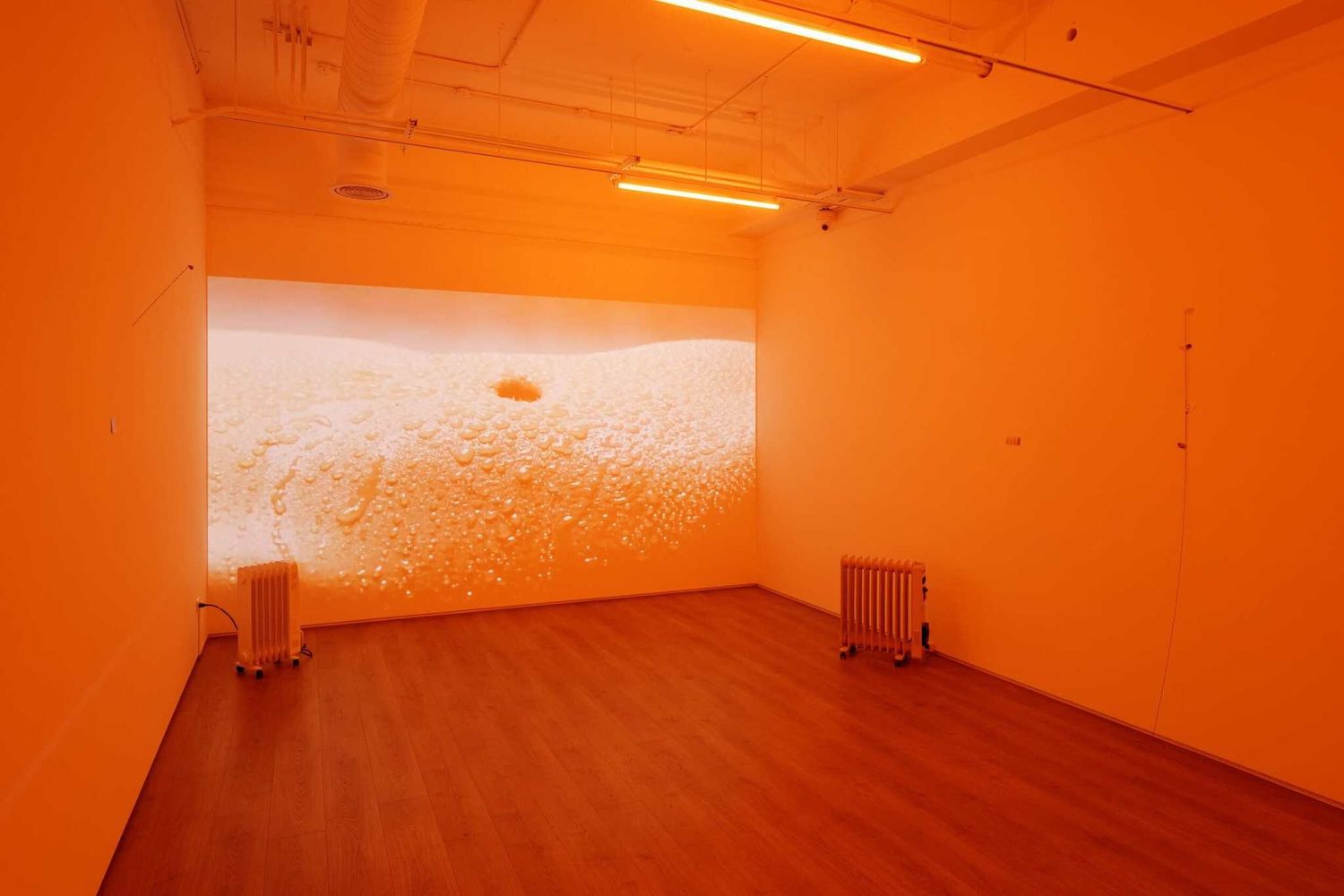
Solo exhibition by Esther Yi-Chun Lin at Künstlerhaus Bethanien, opening 10 September 2026. About Upon entering the exhibition space, one is immediately confronted with a large-scale projection of a sweating belly onto the wall: beads of perspiration emerge from the pores around the navel. Only after a while does one notice that one's own body is also warming up—and that two radiators are running along the side of the room. What Burning Stones: Hot Archives (2022) depicts is transferred to one's own body. The sweating is a metabolic event—a circulation of heat, relaxation, and anxiety—that directly corresponds to the video installation Burning Stones (2022) opposite. There, massaging hands explore the tissue of a body. Esther Yi-Chun Lin's video works are being presented directly alongside each other for the first time at Künstlerhaus Bethanien. Together, they form a sweat chamber in which the human body becomes the object of a forensic investigation into the identity and history of Taiwan. They delineate a territory deeply inscribed with geography, memory, and history—traces that become tangible both symbolically and physically through sweating. How can history be felt? How are landscape, memory, and belonging inscribed on a body? Esther Yi-Chun Lin's work starts with these questions. Body odor becomes a metaphor for history: "I think the odor of the body is like a metaphor for history." The title Burning Stones alludes to the etymology of the English word for sulfur, brimstone, which derives from the Old English bryne (burning, fire) and stān (stone). In Burning Stones: Hot Archives, this burning stone finds its physical counterpart in sweat. Under heat, bacteria decompose it, releasing sulfurous compounds—body odor. Lin equates this sweating body with a sulfur mine. The evaporating sweat fills the air in the room—just as the volcanic sulfur springs in Beitou, Taiwan, blanket the surroundings in steam. From the sweating belly of a woman worried about her odor, historical scenes emerge as fragments. It is colonial archival material that Lin tracked down on the internet, where it circulates freely. From these historical images, she cuts out depictions of indigenous communities in Taiwan – she calls one of these interventions a "biopsy." Interspersed are images of the Datun volcanic group and measurement data on the sulfur concentration in the air during the pandemic, where an elevated value indicates that organic material – including human – is being burned. What emerges, for Esther Yi-Chun Lin, are no longer images, but crystals that have passed through a body: exhaled, deformed, with deposits on the surface. From the imagery processed by the artist, a counter-archive is created – a recurring practice that she continues in this exhibition. On the opposite screen, Burning Stones (2022), the historical paths in Beitou are transferred to the skin by tactile hands. Esther Yi-Chun Lin invited the performer Ho Zhong-Jun to walk a path of the sulfur mines together; this resulted in a performance in the form of a massage. The video shows no landscape, no forest, only massaging hands. Yet it tells a story: from the body, through landscape, map, and colony, to the transformation of the sulfur. The paths to the rivers and mountains where the sulfur mines were located and indigenous workers earned their wages become tangible through the pressure points of the massage. The colonial map dissolves; in its place emerge a tree, a large stone, the sound of flowing water—and the skin itself. It is a landscape where the influences of Spain, the Netherlands, and the Qing dynasty have overlapped, a space where the traces of indigenous communities and local earth deities gradually disappear. The work effects a reversal of perspective: “How do you see a mountain from the mountain’s perspective? A hand from the hand’s perspective?” Orientation is provided not by surveying, but by somatic memory: “the faint smell of rotten eggs, the remembered spot on the body, and a little luck.” The massage comes to an end: “Please remember your personal belongings when you leave. Thank you for your participation.” A reset, as after a treatment—and at the same time, the beginning of a renewed search for identity. Everyone takes what belongs to them; everything else remains behind. The scent stays where it was—with the spirits, the deities, the bodies that have inscribed themselves on the landscape. For Esther Yi-Chun Lin, this scent is a way of telling history: it is inhaled, felt, and experienced on one's own body—like the circulation of a story rediscovered across generations. Text: Keumhwa Kim Read more Toggle Film / Video
Schedule
Starts
-
Fri, Sep 11, 2026 at 12:00 AM
Ends
-
Sun, Nov 15, 2026 at 11:59 PM
Location
10 Kottbusser Str., Berlin, Berlin, 10999, Germany
KB
Presented by
Künstlerhaus Bethanien