Exhibition
Carsten Nicolai – Wave Weave & Sono Obi
Thursday, November 12
12:00 AM - Dec 19, 11:59 PM
Galerie EIGEN + ART
Berlin, Germany
Checking payment status…
Registration
Registration for this event is managed on an external website.
RSVPAbout event
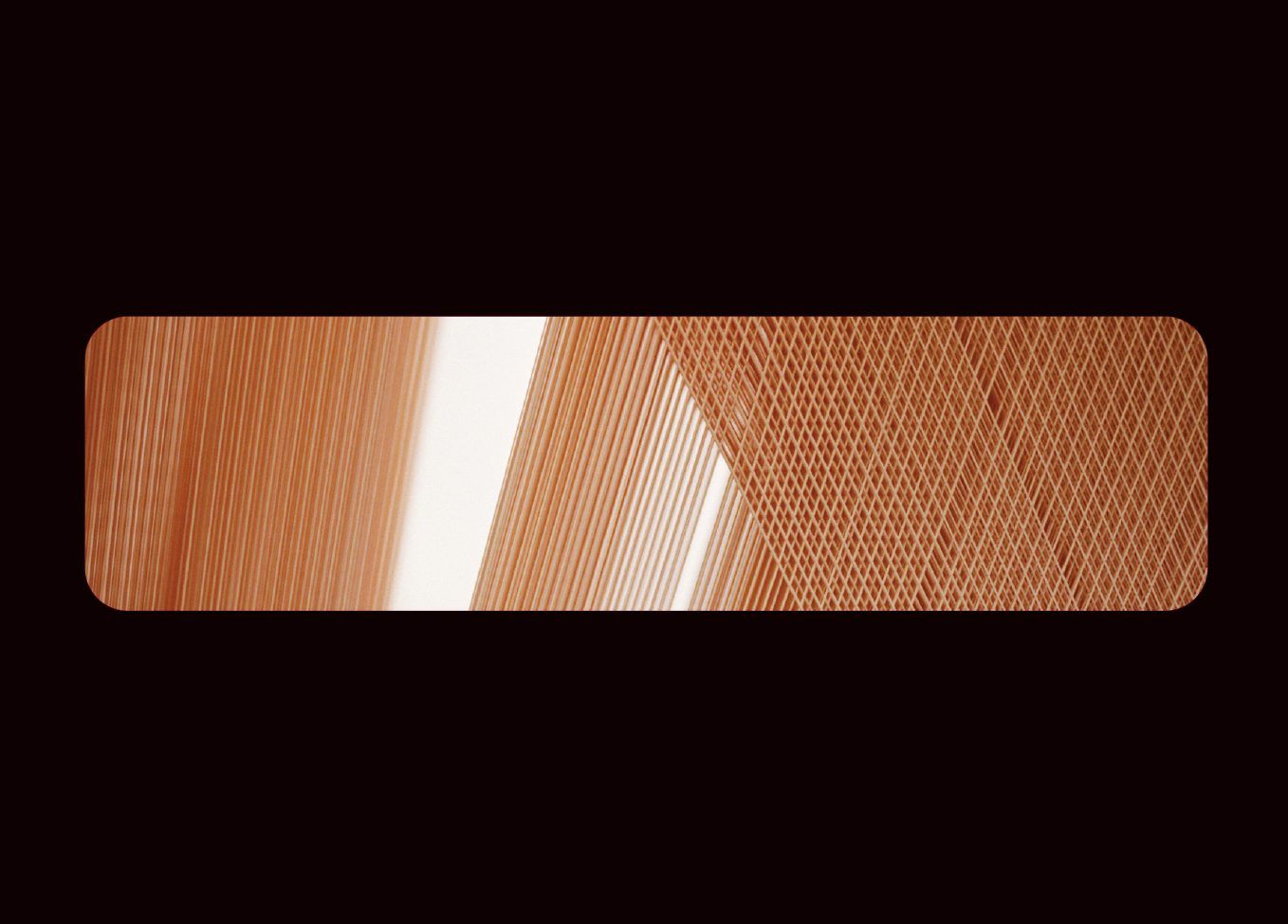
An essayistic visual exploration of the weaving process examining connections between technology and material, pattern and information. About We are pleased to announce the current exhibition by Carsten Nicolai, which opens on Thursday, November 12th at 5 pm in our Berlin gallery. WAVE WEAVE is an essayistic, visual exploration of the weaving process. Instead of viewing weaving solely as a craft or production technique, the film of the same name examines the broader connections: between technology and material, pattern and information, and between a technical process and the cultural and physical landscape in which it takes place. These interfaces appear repeatedly in Carsten Nicolai's work. His artistic practice has long explored patterns, interferences, repetitions, and systems of visual and acoustic organization. He frequently shifts between technological phenomena and structures from his immediate surroundings. The important term "moiré" in Nicolai's work originally comes from the history of textiles. It initially referred to fabrics with a water-like or wave-like appearance. Later, it came to describe the optical interference patterns created by overlapping structures. This interest also has a biographical dimension. Nicolai grew up in Karl-Marx-Stadt, now Chemnitz, a city and region whose industrial history is largely defined by textile production and mechanical engineering. This connection is further explored through a group of nine works from his series * adopted jacquard point paper drawing *. The starting point is a collection of historical jacquard pattern drawings that Nicolai discovered in an abandoned weaving mill in Chemnitz in the early 1990s and has kept in his archive ever since. Originally, these griddled drawings served as templates for transferring textile patterns onto the punch cards that controlled the loom. They thus exist in the space between image and code. For the new works, Nicolai selected seven of these historical sheets and combined them with his own drawings from 2026. In doing so, he brings found industrial notations into dialogue with his visual language and the broader context of *WAVE WEAVE* . In the film WAVE WEAVE, Nicolai focuses on the weaving process itself. Filming took place in the workshops of HOSOO in Kyoto's Nishijin district, where textiles have been produced for centuries using highly specialized weaving techniques. Founded in 1688, HOSOO continues this tradition while simultaneously expanding its methods with modern technologies and digital processes. Nicolai's camera focuses on the production site itself: the looms, the threads, the mechanisms, and the repetitive movements through which a textile gradually takes shape. Instead of documenting the process in the conventional way, the film isolates its rhythms and structures. Mechanical movements, shifting threads, and recurring sequences are arranged into a precise visual composition. Thus, the loom appears not only as a physical device but also as a system for organizing information. Individual threads are arranged, repeated, shifted, and combined until a pattern emerges. In this sense, weaving becomes both the subject of the film and a model for its structure. A second technological process runs through WAVE WEAVE, directly linking the filmed image with its soundtrack. Throughout his work, Carsten Nicolai has consistently sought ways to make otherwise invisible phenomena perceptible, and in particular to give sound a visual form. Sonography offers the possibility of translating acoustic information into a graphic image. This image can, in turn, serve as the basis for converting visual information into sound. Sound and image are thus not entirely separate categories, but rather different forms of expression for interconnected information. This principle creates two visual layers within the film. The first layer is the moving photographic image, depicting the workshops, looms, threads, machines, and the physical process of weaving. The second layer is the visual representation of the soundtrack itself, generated through sonographic analysis. Thus, the soundtrack is not merely an invisible acoustic accompaniment to the film, but acquires its own graphic form. This graphic image is then transferred onto textile. The sonographic representation of the soundtrack becomes the woven structure of SONO OBI. What appears as textile in the film is therefore more than just an object observed by the camera: it also contains a visual representation of the sound that accompanies the film. The various elements of the film are thus coordinated in such a way that they complement and influence each other. The soundtrack, for example, becomes visible as a sonographic image, woven into a fabric. This fabric flows into the photographic image of the film, while the sound with which the process began can be heard alongside it. The photographic image and the graphic image of the soundtrack are therefore interwoven both conceptually and materially. In this sense, WAVE WEAVE can be understood simultaneously as a film, a sound piece, and an extension of SONO OBI. The weaving is not merely what the film depicts; it becomes its organizing principle: sound, image, notation, textile, and moving image are interwoven until the distinction between representation, material, and source begins to dissolve. WAVE WEAVE was created in close collaboration with HOSOO and combines different stories and contexts of textile production with Nicolai's ongoing exploration of sound, perception, signal processing, notation, craftsmanship and technology. In collaboration with HOSOO Kyoto. Courtesy Galerie EIGEN + ART Leipzig/Berlin © Studio Carsten Nicolai, NOTON. ARCHIVE FOR SOUND AND NON-SOUND Read more Toggle Installation Performance / Live Art Film / Video Mixed media
Schedule
Starts
-
Thu, Nov 12, 2026 at 12:00 AM
Ends
-
Sat, Dec 19, 2026 at 11:59 PM
Location
Auguststrasse 26, Berlin, 10117, Germany