Exhibition
White Borders
Friday, November 6
12:00 AM - Jan 30, 11:59 PM
Cuchifritos Gallery + Project Space
New York, United States
Checking payment status…
Registration
Registration for this event is managed on an external website.
RSVPAbout event
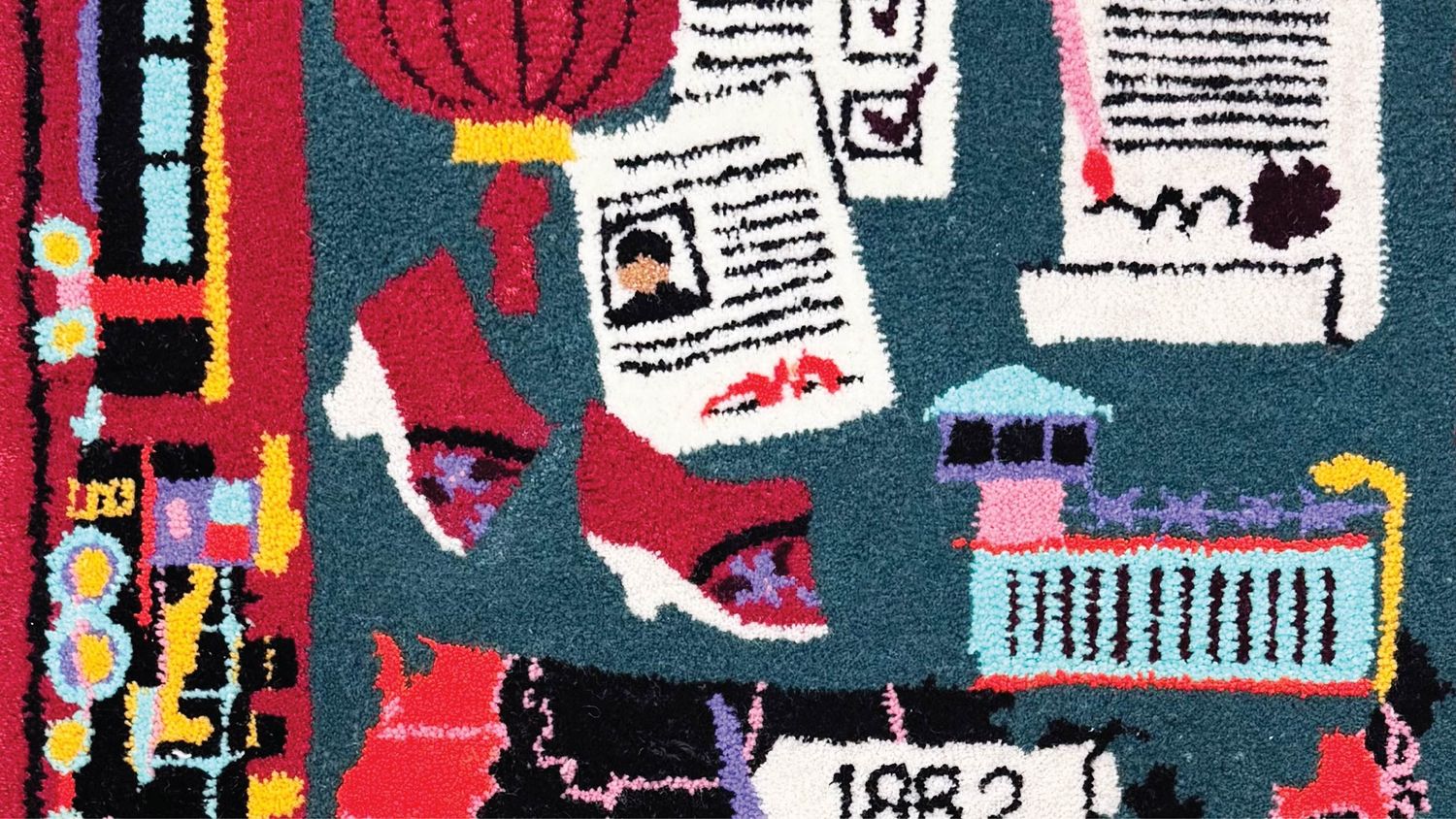
Through hand-tufted rugs, patterned wallpapers, and familiar domestic ornamentation, Herr turns the visual language of comfort into a sharp look at American identity, immigration policy, and state violence in her solo exhibition at Cuchifritos Gallery. About Cuchifritos Gallery + Project Space (a program of Artists Alliance Inc.) is pleased to present White Borders , a solo exhibition of new works by Johannah Herr, on view November 6, 2026, through January 30, 2027. Through a vivid maximalism of hand-tufted rugs, patterned wallpapers, and familiar domestic ornamentation, Herr transforms the visual language of comfort and belonging into an unsettling examination of American identity. Beneath saturated colors and decorative surfaces, histories of displacement, exclusion, and state-sanctioned violence emerge, challenging the myth of the United States as a welcoming “melting pot.” White Borders builds on Herr’s ongoing series American War Rugs , hand-tufted carpets that borrow the visual and material language of Afghan war rugs to critique U.S. state violence at home and abroad. Here, the rugs trace a broad history of American immigration policy, examining who is permitted to become a citizen, who can enter the country, and who can move freely within its borders. The works reference the Trail of Tears, the Chinese Exclusion Acts, Japanese American incarceration, Mexican Repatriation, Operation Wetback, and ICE crackdowns under the second Trump administration. Paired with wallpapers, the rugs initially read as benign decorative patterns but, on closer inspection, reveal an archive of ICE violence gathered over two years from Herr’s own Instagram feed. Among the many forms that public and private space take in America, Herr turns her attention to the home, often regarded as the most familiar expression of personal safety and comfort. By distorting its ornamental conventions, she unsettles the promise of refuge that domestic space represents, exposing the histories of violence, displacement, and domination embedded in the structures that sustain it. From the displacement of poor and BIPOC communities for infrastructure development to the availability of inexpensive commodities made possible through exploited labor in the Global South, the comforts of some have long depended on the vulnerability and exclusion of others. Herr’s speculative domestic objects make these relationships visible, using the familiar language of the home to examine the intersecting forces of race, class, and immigration. The exhibition takes its name from Reece Jones’s 2021 book, White Borders: The History of Race and Immigration in the United States from Chinese Exclusion to the Border Wall . Like Jones, Herr challenges the mythology of the American melting pot, tracing the ways in which U.S. immigration policy has historically reinforced racial hierarchies and protected the privileges of whiteness. For Herr, a third-generation immigrant descended from families in Slovakia and Italy, the narrative of the melting pot loomed large. She grew up with stories of her family’s journey through Ellis Island and their transition from railroad laborers with limited formal education to the college-educated middle class. The consolidation of distinct European national and cultural identities into a privileged category of “whiteness” was largely absent from these accounts. What persisted instead was a tenacious belief that any immigrant could achieve the American Dream. Yet U.S. history tells another story. The nation’s first naturalization law, passed in 1790, restricted citizenship to “free white persons.” An 1870 amendment extended eligibility to people of African descent, while Indigenous Americans and other populations remained excluded from naturalization. Although the Fourteenth Amendment established birthright citizenship in 1868, citizenship was not extended to all Indigenous Americans born in the United States until the Indian Citizenship Act of 1924. White Borders also examines the persistence of exclusionary rhetoric across generations. Donald Trump’s “Make America Great Again” slogan recalls Ronald Reagan’s 1980 campaign language, “Let’s Make America Great Again,” and earlier appeals to a supposedly threatened national identity. In the 1920s, President Calvin Coolidge invoked the imperative to “Keep America American” while signing the Johnson-Reed Act of 1924, which barred immigration from Asia and severely restricted immigration from outside Northern and Western Europe. In 1935, Langston Hughes offered a pointed response to such promises of national greatness in his poem “Let America Be America Again,” questioning whether the freedoms celebrated in American mythology had ever been fully realized for those historically excluded from them. Through an immersive installation that brings these histories into the familiar visual vocabulary of domestic life, Herr invites visitors to reconsider the relationships between personal comfort, national belonging, and systemic violence. Her use of soft materials, decorative excess, and recognizable motifs creates an unexpected point of entry into difficult histories, asking what becomes visible when the spaces and objects associated with safety are understood in relation to the systems that make them possible. White Borders is made possible through the Dual Workspace Residency Program presented by Artists Alliance Inc. and Dieu Donné. Johannah Herr was the resident artist for the 2025 season. Read more Toggle Installation Multi-disciplinary Crafts Mixed media
Schedule
Starts
-
Fri, Nov 6, 2026 at 12:00 AM
Ends
-
Sat, Jan 30, 2027 at 11:59 PM
Location
88 Essex Street, (inside Essex Market), New York, New York, 10002, United States